
Her wedding day, seventy years on: bringing a 1950s photograph back to the mantelpiece
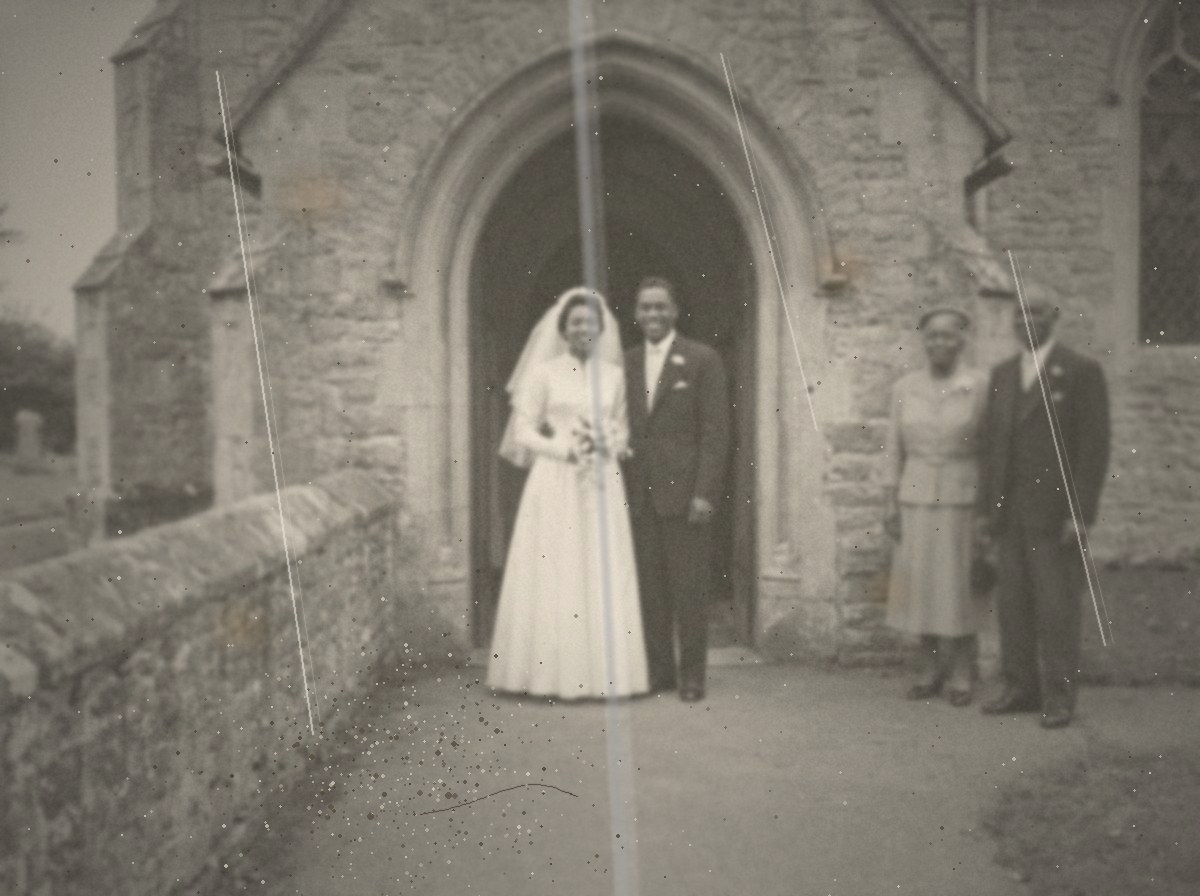
Before
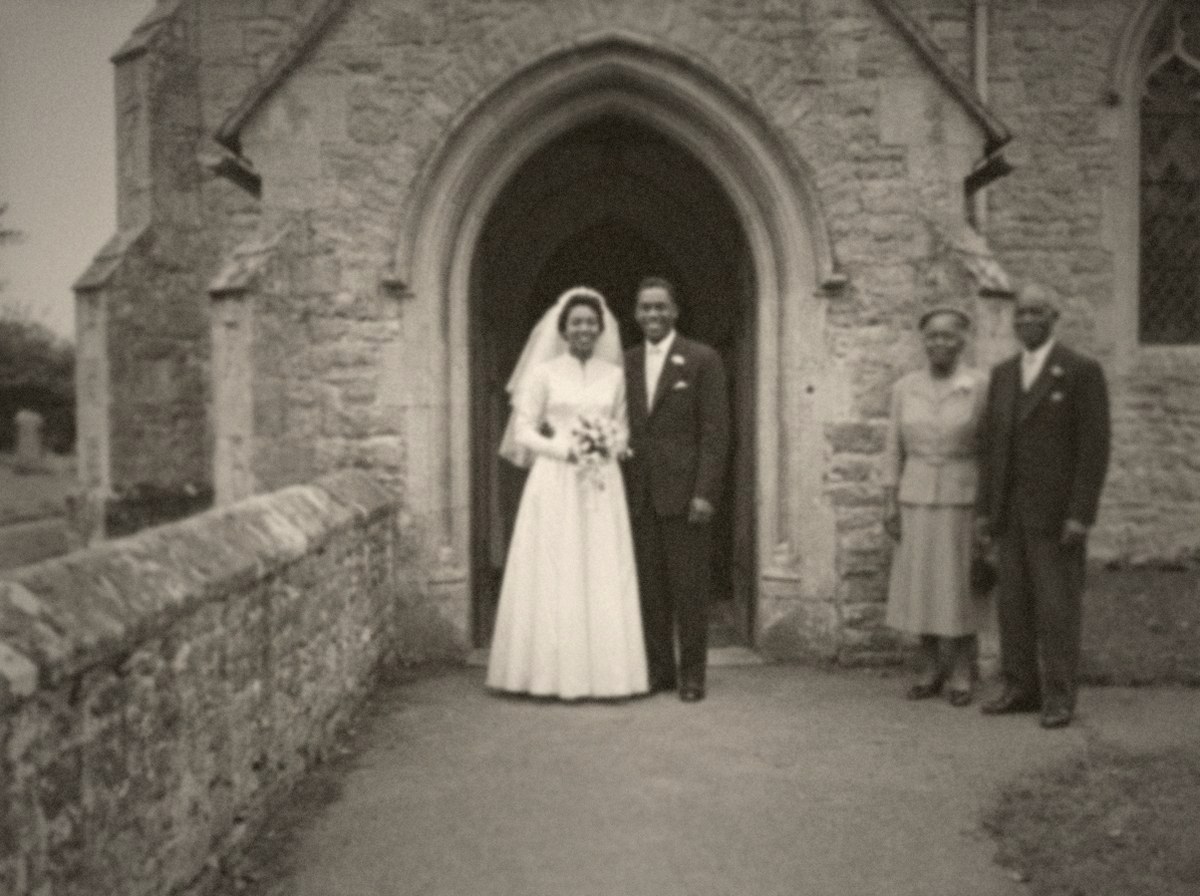
After
There is a photograph like this in a great many houses. It is usually in the drawer rather than the album, because it is too big for the album, and because at some point somebody was going to have it framed.
In this one, a bride and groom are standing in the doorway of a small stone church, in 1952. She is holding a small bunch of flowers in front of her with both hands. He is standing very upright, the way men stood for photographs then, and he is smiling in the slightly surprised way that people smiled when they were told to hold still. Behind them, to one side, stand her parents. Her mother’s hands are clasped. Her father has his hat off.
Nobody in the picture is aware of how soon the world will change, or which of them will still be in the room when the photograph is next looked at properly. That is true of every photograph, and it is what makes this one worth bringing back.
What seventy years in a drawer does
The paper has gone slightly grey. Not dramatically, the way a cheap print goes yellow, but enough that the whites in the dress no longer read as white and the whole picture has flattened out into a soft grey haze with no real blacks in it.
There is a crease down the middle, from the fold somebody put in it to make it fit in an envelope. It passes across her shoulder and up through the left side of her face, and it catches the light in a way that makes her look like she is standing behind a thin wire.
And the brightness of the day has gone with it: the dress that must have been blinding white in the sunlight has settled into grey, and the faces, which are the whole point, have gone flat and a little soft.
What comes back first
The contrast, and it is startling. These older photographs hold a wide range of greys, and nearly all of it is still in there underneath the years, waiting to be brought back out. When it comes back, the blacks in his suit go black, the door behind them goes the colour of stone, and the whole picture gains a depth it has not had since the year it was taken.
Then the crease closes. It is not painted over, which is the important part. It is folded shut, its bright edge and its dark edge brought back to the level of the paper around it, so the surface reads as one photograph again. Then the mark of the teacup, and the ring of it, and the dust that has settled on the surface over seventy years and has been quietly making everything look tired.
And then her face, with all of its expression, at the size somebody stood for the camera.
Black and white, and the question of colour
People ask, and it is a fair question: can it be colourised.
It can, and it can be done with care, taking the period, the season and the clothes into account. But it is worth being clear about what it is. A black and white photograph did not record colour. Adding it is a decision somebody makes on your behalf, and the most careful version of it is still an interpretation rather than a memory.
Our own view, offered rather than urged: keep it black and white, and let the repair do the work. A properly restored black and white photograph from that year, with the greys back and the surface repaired, looks like a photograph rather than a modern picture of an old one, and it will still look right on the wall in twenty years.
If you want it in colour, ask. You will get it, and you will be told honestly which parts are known and which were chosen.
Then it goes on the mantelpiece
The thing that happens after a photograph like this comes back is always the same, and it is the reason to do it.
It stops living in the drawer and gets framed, usually by whoever in the family is most organised, and it goes somewhere in the house where people will walk past it. And then, at the next gathering, somebody’s grandchild stops and points at it and asks who the people are. Not just the bride and groom, who are easy, but the two standing behind them.
And somebody says: that is your great-grandmother, and that is her mother, my grandmother, who I last saw in this house.
That moment, one generation handing a name to the next, is what these photographs are for, and it is worth every one of those seventy years. There is still time. Take it out of the drawer, lay it flat on a table in daylight, photograph it from above with your phone and upload that. Nothing goes in the post, and she stays in your hands. She has waited this long. Another week will not hurt, and there is no reason to wait either.
Questions people ask
The crease goes straight through her face. Can that be repaired?
Usually, yes. A crease is a fold in the paper, so it has a bright edge and a dark edge, and both are closed and rebuilt until the surface reads as one photograph again.
Will you add colour to a black and white wedding photograph?
Only if you ask for it, and we will tell you plainly that colour added to a black and white photograph is an interpretation rather than a fact. Many people prefer to keep the original and have the dust, the creases and the contrast dealt with.
Can it be made large enough to frame?
A well-kept photograph from that era carries a remarkable amount of detail. We can prepare a file that holds up at a good size on a wall, and we will tell you honestly how far it can reasonably go.
There is a stain across the bottom corner. Is it worth sending?
Yes. Water staining and the discoloured ring it leaves are among the faults that respond best, and the paper underneath can be rebuilt to match around it.
The photograph is torn in two. Is that the end of it?
Not usually. Torn edges are joined so the two sides meet again and the paper texture across the join is rebuilt. If a piece of the picture is genuinely missing, you will be told before you pay.
Upload a photograph and see it repaired
You will see the result before you pay anything, and you keep the watermarked copy either way.
Start: Pick a PhotoFree to repair. The free copy carries our watermark, which is what keeps it free.